
Young Men Are Popping ED Pills — But Not for ED
The Pill in the Nightstand Nobody Wants to Talk About
Let's be real for a second. If you're a man in your 20s or 30s and you've got a BlueChew subscription, you're probably not telling your boys about it over brunch. And you're definitely not posting it on the 'gram. But here's the thing — you're not alone. Not even close. A quiet revolution is happening in men's health, and it's being driven not by older men managing age-related decline, but by young, physically healthy men who are using ED drugs for a reason that has almost nothing to do with erectile dysfunction itself.
The real driver? Performance anxiety. And the conversation around it is long overdue.

The Numbers Don't Lie
Here's what the data is telling us, and it's genuinely striking. Research shows that ED now affects approximately 26% of men under 40, with nearly half of those cases classified as severe. A large-scale survey of Swiss men aged 18 to 25 put the figure even higher, at 30% prevalence, independently linked to mental health struggles and off-label medication use. And in a survey of over 2,500 people aged 18 to 38, 80% of men reported experiencing erection trouble at least once during sex — without any clinical diagnosis of ED whatsoever.
That last number is the one that should make you sit up straight. Because what it tells us is that the vast majority of young men reaching for sildenafil or tadalafil are not broken. They are not sick. They are stressed, anxious, and living inside a culture that has quietly raised the stakes of sex to an almost impossible level.

So What Is Performance Anxiety, Really?
Performance anxiety is not a character flaw. It is a physiological event. When your brain perceives a high-pressure situation — a new partner, a long dry spell, a moment where you feel like you have something to prove — it triggers your sympathetic nervous system. Adrenaline spikes. Blood vessels constrict. And suddenly, the very thing you want your body to do becomes the one thing it refuses to cooperate with.
As Cleveland Clinic explains, for younger men, the primary cause of erectile difficulty is almost always psychological, not physical. Good solo erections but issues with a partner? That is a textbook mind-body disconnect, not a medical emergency. But try telling that to a 27-year-old in the moment. One failed encounter plants a seed of doubt. That doubt becomes anticipatory anxiety. That anxiety becomes a self-fulfilling prophecy. The cycle compounds, and before long, a man who is perfectly healthy is questioning everything about himself.

Enter the Telehealth Revolution
This is where companies like BlueChew, Hims, and Ro stepped in and changed the game entirely. By moving the consultation online and delivering medication in discreet, chewable formats that look nothing like a prescription bottle, they eliminated the single biggest barrier to young men seeking help: embarrassment.
No pharmacy line. No awkward conversation with a pharmacist. No pill that looks like a medical device sitting on your dresser. BlueChew's chewable sildenafil and tadalafil tablets are designed specifically to address both the physical and psychological dimensions of performance anxiety, and the user reviews reflect exactly that. Men are not reporting that these drugs "fixed" a dysfunction. They are reporting that the drugs gave them enough reliable physical support to break the anxiety cycle — to have one good experience that reminded their nervous system that everything is fine.
That confidence reset, as Ubie Health notes, is often the entire point. PDE5 inhibitors like sildenafil and tadalafil achieve clinical success rates of 60 to 80% in anxiety-linked cases, not because they manufacture desire, but because they remove the physical uncertainty that feeds the mental spiral.

The Digital Culture Factor
We cannot have this conversation without naming the elephant in the room: the internet has fundamentally warped what young men think sex is supposed to look like. Pornography consumption, unrealistic body image content, and the relentless performance culture of social media have created a generation of men who are cognitively distracted during sex — comparing, evaluating, and judging themselves in real time instead of being present.
As Psychology Today has reported, this cognitive interference is a significant and underappreciated driver of ED in younger men. Add to that the TikTok pipeline of "testosterone maxxing" content that falsely frames every sexual difficulty as a hormonal deficiency — and you have young men chasing the wrong solutions while the actual problem, anxiety and mental load, goes unaddressed.
A study of military men under 40 found that poor genital self-image was directly linked to sexual anxiety and elevated ED risk. This is not about physical inadequacy. It is about the stories men are telling themselves, often stories written by content they consumed online.

What the Experts Actually Think
Doctors are not uniformly opposed to young men using these medications, but they are asking for more nuance. The consensus is clear: PDE5 inhibitors are FDA-approved, medically safe for most men when properly screened, and can be genuinely therapeutic for anxiety-linked cases. The concern is not the drug itself. The concern is using the drug as a permanent workaround instead of a bridge to something deeper.
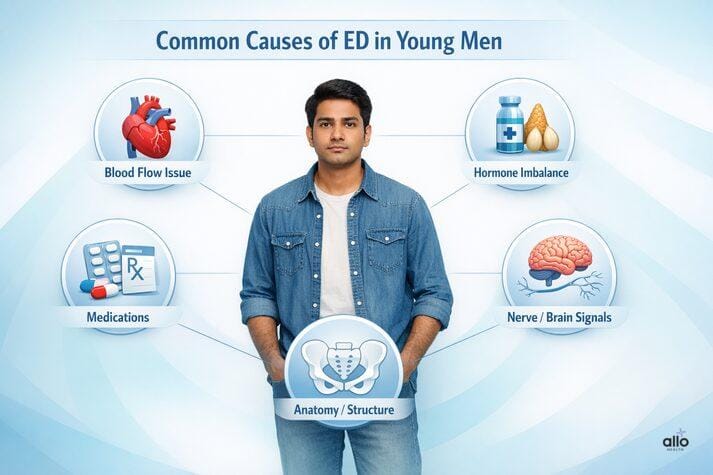
As a 2025 narrative review in PMC outlines, ED in young adults is increasingly recognized as a multifactorial condition with strong ties to depression, anxiety, relationship quality, and lifestyle factors. Treating it with medication alone, without addressing the psychological roots, is like putting a bandage over a wound that needs stitches. It helps in the moment, but it does not heal the underlying issue.
The most effective approach, according to clinicians, combines PDE5 inhibitors with therapy, stress reduction practices, honest communication with partners, and a hard look at lifestyle habits — sleep, alcohol use, exercise, and screen time included. Comparative reviews of platforms like Rugiet, Ro Sparks, Hims, and BlueChew increasingly reflect this, with users gravitating toward multi-approach products that address both the physical and the mental dimensions simultaneously.
The Risks You Need to Know
This is the part where we keep it fully real with you. These medications are not candy, and the fact that they are accessible online does not mean they are consequence-free. Common side effects include headaches, flushing, nasal congestion, back pain, and in some cases, vision changes. The more serious risks involve interactions with blood pressure medications and certain cardiovascular conditions — which is exactly why a proper medical consultation before use is not optional, it is essential.
There is also the question of dependency — not physical addiction, but psychological reliance. If a man reaches for a pill every single time rather than building genuine confidence and addressing root causes, he may find himself unable to perform without one. That is a different kind of problem, and it is one worth taking seriously.
Finally, Cleveland Clinic urges that persistent ED in young men should always prompt a broader health screening. In rare cases, it can be an early signal of cardiovascular issues, hormonal imbalances, or diabetes. Do not let the convenience of a telehealth subscription replace an actual relationship with a doctor who knows your full picture.

The Bigger Conversation We Need to Have
Here is what this trend is really telling us, underneath all the marketing and the mint-flavored packaging. Young men are scared. They are navigating sex in an era of impossible standards, reduced privacy, heightened judgment, and a cultural script around masculinity that leaves almost no room for vulnerability or imperfection. They are finding solutions in the only spaces that feel safe — anonymous, online, and judgment-free.
That is not weakness. That is adaptation. But adaptation without awareness can become avoidance. And avoidance never actually solves the thing you are running from.
The most sophisticated move a man can make is not finding a better pill. It is understanding why he needed the pill in the first place — and deciding, with full information and without shame, what he actually wants to do about it. That might include medication. It might include therapy. It might include an honest conversation with a partner. It almost certainly includes being a little kinder to yourself than the internet has taught you to be.
The untold angle here is not that young men are using ED drugs. It is that they are quietly, desperately searching for permission to be human. That permission does not come in a chewable tablet. But sometimes, the tablet buys you enough breathing room to find it.